Author Archives: A bear

What was before bears?

tree bearness

I have no idea what came before bears. If I had to guess, I would say lots of things. Trees seem older than bears. I bet trees were around long before bears. Maybe ants? Ants seem like they have been around much longer than bears. The sky. There is no way any bear has been around longer than the sky.

I suppose trying to figure out all of the things that came before bears is a little too grand of a task. After all, it seems like everything is older than bears, especially mold, rocks, and most frogs (their wisdom proves that). I need to narrow down my line of questioning.

What was before bears that led to bears?

I have no idea what was before bears that led to bears. I have some guesses, but that is really all they are: guesses. I do not have any hard evidence like bear bones I dug up or a lovely picture of an old bear.

Bear-trees. That is one of my hypotheses. I think it might be possible trees and bears used to be one thing at one time, a very very long time ago. I feel connected to trees in an inexplicable way. They are so silent and so peaceful and so nice about me chewing on them, collecting their stick children for further chewing, and letting me have the moss on their sides for possible chewing. Trees give. Maybe I am being too self-centered, but sometimes I feel like trees give specifically to me (and presumably all bears). That connection feels ancient. It feels like trees have been giving to bears since before bears were even bears and trees were even trees. So that leads to me thinking that maybe a very, very long time ago we were one thing.

I know this is hard to visualize, but it is very nice to think about. The peaceful, giving life of a tree is something I understand, so it makes sense to me that bears and trees might have once shared lives.

Another guess I have about what was before bears that led to bears is based around another thing that feels ancient and old to me. Dirt. Maybe bears are just fuzzy dirt. Dirt seems like it has been around for everything. Just ask it. Dirt even manages to be more silent and peaceful than trees. I have a myth in my brain that involves dirt realizing it wanted to try being more than dirt by being like all the creatures and non-dirt things that step all over it all the time. In this myth I made up, dirt decides to be a thing that is still rather silent and peaceful but gets to be fuzzy and eat fish. So some of dirt becomes the first bear. That might be me just making up stories, but would it not be so pleasant to consider it true? Maybe everything comes from dirt like that.

Trees and dirt are nice, but I do think those two ideas are more me trying to find commonality in the things I admire about the forest and less about what was actually before bears that led to bears. My practical guess for this situation that I do not truly understand is that all bears came from smaller bears. This line of thinking seems the most reasonable (and boring) to me. As much as I like to believe that I am the product of trees and dirt, I have a feeling that I am actually the product of just some other, smaller bear. A bear that is tiny and helpless and trying to figure out the forest just like I am. A bear that wants to be of trees and dirt and not an even smaller bear. A bear that likes tiny fish in tiny rivers and collects tiny rabbit skeletons. I suppose that is not so awful. It is not as magnificent as dirt and trees, but it is nice to think about a creature that is like me in every way but just tiny.

I will probably never actually know what led to bears, what was before bears, or why I feel more connected to dirt and trees than I do anything else in the forest. I like not knowing, though. It lets my brain wander into things that might or might not be, and who knows if I would be able to do that if I actually knew the answers to all of these questions.

I am a bear.

If you would like to try being a bear, why not read some of the bear adventures available on this very site?
I probably had a mom.

bear mom

I cannot remember, exactly, what my mom was like. I know she, like me, was a bear. I know she occasionally licked my fur for me. I know she showed me how to climb a tree. I know she smelled like dirt, which is lovely.

I also know, at some point, she was no longer part of my life. I know I was with other bears like me one day and then not with them on another day. What happened between those two bookend memories is a mystery to me. Not knowing what happened in that empty space leads to me doubting everything before as well. How much of what I remember of my mom (which is already limited to vague images and smells and sounds) is made up? How much actually happened?

Is my mom a ghost bear?

I do not know, but it is a better supported idea than anything else I have. If she is (was) a ghost, at least she is something more than just loosely put together, possibly unreal thoughts in my mind.

I have dreams about her sometimes. It is usually the same dream. I am me, but I am a tiny me, perfectly proportioned. A large bear is holding me against her belly fur and saying something very softly to me. I cannot understand it, but I know it makes me feel good and warm and never sad and always hugged. The dream never lasts long, and it is usually alarming to go from it to my dark cave, alone, not being held by a large bear.

Why do my dreams do that, though? I do not understand the reason for reminding me of something that makes me feel like I am missing an important piece of who I am or what being a bear is. If it never happened, then what parts of my past experiences are my dreams stitching together to create those images and sounds and feelings? And if it did happen, why can I not remember it, specifically or in any discernible detail? There is such a noisy blankness that rests in my memories, showing nothing decipherable but reminding me of something that must have mattered.

I cannot be a mother bear, so I do not know the thoughts or considerations that go into bear motherhood. I am certain that raising a cub or two at a time is no easy thing, but is it intentional to eventually leave your cubs without a trace of the warmth or nurturing you once provided? Is it how cubs grow into bears? Is it hard? Is it necessary? It must be necessary. I hope it is necessary.

I do not know if even being able to remember the split from my mom I must have experienced would help me at all. Perhaps I would just have dreams of that instance if I could remember the exact moment. Dreams of whatever loneliness or abandonment I must have felt the moment I ceased being a bear cub. The moment everything probably started being difficult. Those dreams would probably not be as comforting as the ones where I am being held up against belly fur, feeling good and warm and never sad and always hugged.

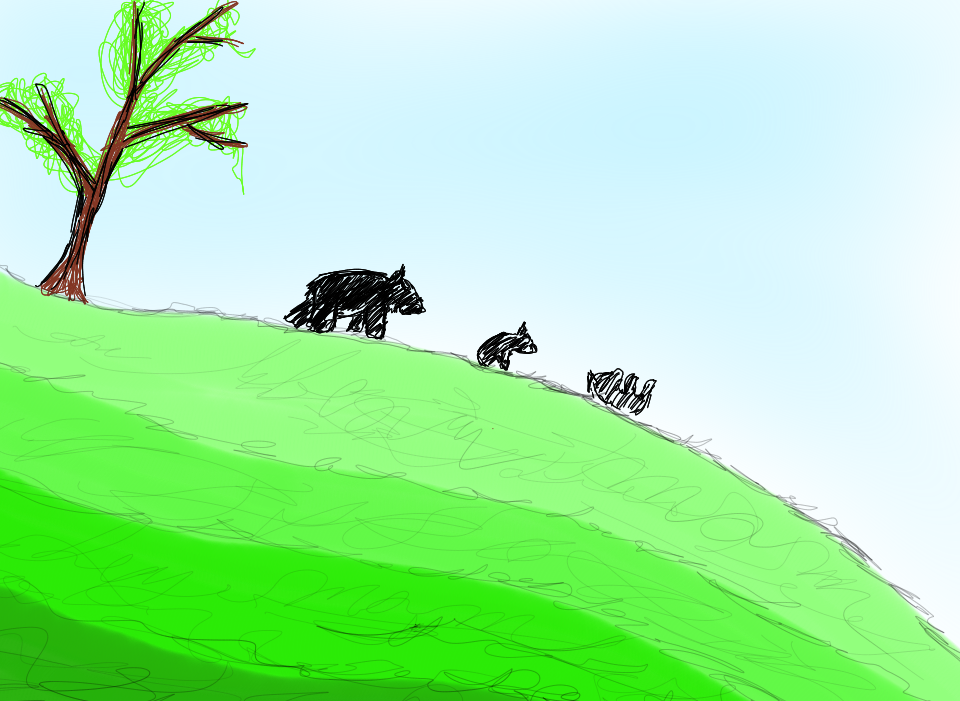
I remember seeing a group of bears wander the forest once. Two tiny ones being shadowed by a big one, a mother bear. I followed them for awhile (for selfish reasons at first since they probably had food or were going to food).The mother bear cautiously traversed the dense forest, moving branches to help her cubs and acting as an impenetrable shield against potential predators. One of the cubs tripped and rolled down a hill at one point. The mother bear followed, licked the little one’s scruffy fur, and helped push it back up the hill.

They finally reached the river. The mother bear began showing the cubs how to swim and hurl their tiny paws into the water for fish. I was near a tree away from the river when she saw me. She gave me a knowing glance and then quickly ignored me. I left.

I am a bear.

“Boris the Bear’s Circus Adventure Extravaganza of Suffer for Lonely, No” is the latest adventure you can read on helloiamabear.com! Please enjoy!

Sometimes raccoons pressure me into eating things.

demon raccoon

I like to eat most of the things I find. Leaves, cans, unidentified animal parts, flowers, leftover human things in human tents, human tents, sticks, air. Eating is one of my favorite things to do, so it is generally very easy to convince me to eat nearly anything. A raccoon I met recently proved to me there were exceptions.

It was in a dumpster behind a drug store where I found a plastic bag filled with a very dark liquid that smelled strange. I poked around it for a bit. I sniffed it. I tasted it. I even lapped a bit of the liquid into my mouth. It was sour and unpleasant. It was one of the first things I had found in a dumpster that I did not want to eat right away.

I turned around and walked away.

Right as my snout pointed toward the next direction I was going to scavenge for more eats, a raccoon startled me.

It stared me down.

It did not make a single sound.

Its bushy, striped tailed sprung up as it walked toward me. For some reason, I felt compelled to walk backward as it approached. I could have easily ignored the creature and ran into the forest, but something made me take a step back. And another step. And another. I kept creeping back as the raccoon walked nearer and nearer until my hind quarters smacked the dumpster I was originally walking away from.

The plastic bag was there. The raccoon saw it. She poked around it for a bit. She sniffed it. She tasted it. She even lapped a bit of the liquid into her mouth.

She kept lapping the liquid. Was it not sour and unpleasant to her? Why did this strange matter not bother the raccoon? Was she immune? Did she know something I did not?

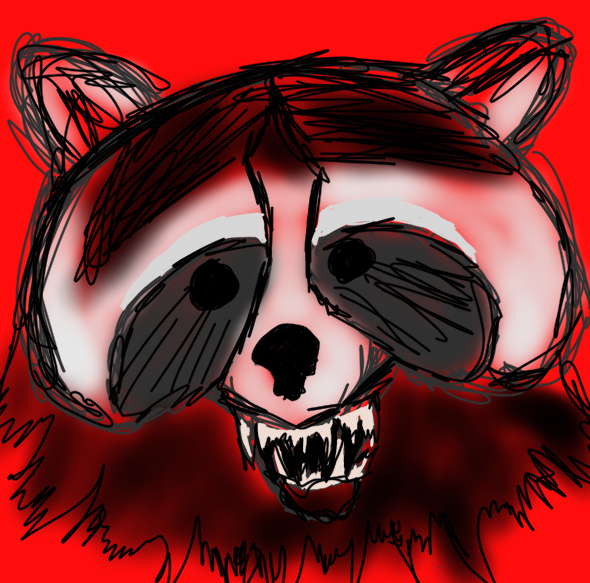
Every question I had was interrupted when she turned her sharp looking face toward me with her teeth gritting, her wild sneer blinding my thoughts. She stared. I stared.

This inaction went on for a very long time. The hot sun baked the unpleasant liquid as exchanged intensity through our eyes.

Finally, the raccoon snapped her jaws around the plastic bag and dragged it toward me.

The hissing began.

I had no idea what she wanted at first. I tried to back away. More hissing. I tried to sit and continue the staring. More hissing. I tried to speak of my discomfort. More hissing.

After a great deal of trials and errors and mistakes and hissing, I figured out what the raccoon wanted.

I pushed my nose into the plastic bag. The hissing quieted. She continued to stare. I averted my eyes away from the bag and toward her. Light hissing. I put my face into the plastic bag. No hissing. The smell was awful. The taste was now sour and warm. It was terrible.

The raccoon kept staring, her glare keeping my brain frightened and my nose nestled in the bane of my senses.

Before long, the liquid was inside my belly, rumbling my insides and making me dizzy. It was gone, though. But so was the raccoon. I looked all around me, trying to figure out exactly what had happened here. Was she merely a figment of my imagination? Did my mind conjure an aggressive raccoon to make me experience something I shied away from? Why am I so afraid of raccoon hissing?

This experience left me questioning many things about my personality and what I know about the forest and its inhabitants. It also led to some of the most terrifying sounds my belly has ever made. But like with any experience, I did learn something. Raccoon sounds are fear-inducing demonic screeches that can drive you to insanity. I do like raccoons, though.

I am a bear.

“Boris the Bear’s Circus Adventure Extravaganza of Suffer for Lonely, No” is the latest adventure you can read on helloiamabear.com! Please enjoy!

I took a nap on some ants.

ants (2)

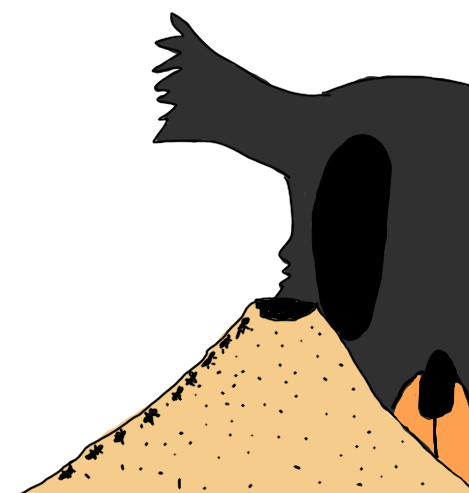
I took a nap on some ants. I did not do so out of malice. In fact, it was never my intention to sleep on ants at all. Sometimes, when spontaneous naps strike you, the number of ideal places to lay your fuzzy head dwindle. A bear (me, for example) must work with what is around them. In this case, what seemed to be comfiest place on the forest floor was an ant hill.

The tiny mound looked soft and inviting. Little did I know, my carelessness would cause a kingdom to fall.

I woke to the sound of hundreds of tiny voices crying out in terror, pining over the destruction of their home. I sat up to survey the damage. It was severe and undeniably horrible.

What had I done?

A few surviving colonists clung to my nose. Some were frantically shouting in my face. A few were biting me. But the pain they inflicted upon my muzzle was nothing compared the remorse that filled my heart.

I begged for their forgiveness, but there was none to be had. The ants could not let this atrocity go unpunished. With tears welling in my eyes, I accepted whatever fate the small insects had planned for me. There was much deliberation over what course of action to take.

After what seemed like an eternity of silence, one of the ants simply said, “You must rebuild, bear. Make right your wrongs.”

I agreed. I told them it was only fair. Reconstruction would begin immediately (after I finished my nap, of course). Tiny cries of protest ringed in my ears. Some more nose biting occurred.

Realizing I would not get to complete the grievous act that led to my punishment in the first place, I set out into the forest to find supplies. I came back with the essentials for any reconstruction

  • Leaves
  • Six sticks
  • Napkins covered in some kind of spicy sauce
  • Three ribs from a rabbit skeleton I had been saving for a special occasion
  • Dirt in an empty aluminum can that I chewed on

I placed the tools on the ground before the displaced ants.

“What’s this?” asked one of them.

Certain these ants had never encountered such items (with the exception of dirt; they seemed to be very familiar with that), I explained what they were.

One of the ants suggested they rebuild the hill themselves. It was a bit insulting. Now, I will be the first to admit I have never built an ant hill, but I suspected their structure could not have been too complex. After all, it looked like a cone dirt pillow. I had made many piles of dirt into lovely pillows for nothing more than my own enjoyment. Surely this would be no different.

I was terribly wrong.

It turned out ants are very competent builders. There was so much beneath the surface I did not understand. After trying to shove the saucy napkins into an opening of the collapsed hill, the ants told me to stop. I had done enough.

I thanked them for the opportunity to try my hand at a new trade. They did not reply kindly. Instead, they demanded I leave behind the leaves, the can full of dirt, and one of the rabbit ribs (for some strange reason).

Feeling slightly accomplished (and slightly beaten down), I trotted back to my cave to resume my nap. As the blanket of sleep began to fall over me, I wondered if other complex things in the world seemed so simple at face value. I am a bear, and inside, I am still a bear (I think). Is Rob (the squirrel) a squirrel on the inside or is his squirrelness simply a facade?  Where does the outer layer of reality stop and why can our core beings be that outer layer? Why did the ants want my aluminum can?

I woke up a few hours later, hungry. As I exited my cave to do some foraging, I stepped on a wasp nest that had fallen from a tree.

Wasps are not as complex as ants or squirrels or bears. They like to sting things. That is about it.

I am a bear.

“Boris the Bear’s Circus Adventure Extravaganza of Suffer for Lonely, No” is the latest adventure you can read on helloiamabear.com! Please enjoy!


Boris the Bear’s Circus Adventure Extravaganza of Suffer for Lonely, No

You are bear.

Being bear hard, terrible life of nothingness in cage that is rust and bad. You life at circus. You feel pain constant. You hear scary music always. You want end pain but pain no end. Never end. Your suffer is forever no matter how you choose to living your life of lonely. Cage your only confidant. Death your wish, but will never coming because suffer is only one.

You look around cage. It rust. Chunks of bear hair cover floor and mock your cold. It have blood on many spaces of it. You feel cold air of circus sting open sore.

Everything hurt.

You choosing to…

I saw two mice fighting today.

mouse (2)

I did not know what to do. The two mice were hurling tiny, rage-filled fists at one another, tearing fur from skin, and biting. Their tiny shrieks of pain and anger echoed through the forest. I tried to make a fearsome growl at them to curb the violence, but it did not work. They kept going and going.

I watched.

Upset.

And helpless.

Finally, they stopped. I did not intervene here, either. I wanted each mouse to go its separate way, and I figured any intervention from me would be largely met with more violence in one way or another.

I could not tell if the mice were reconciling or just taking a break. The tension was agonizing.

And then a bird flew down and clenched its powerful talons around one of the mice. The two flew away. The remaining mouse then picked up a small kernel of corn and ran away.

All of that over a kernel of corn?

The violence. The shrieking. The terror.

Over some corn.

I had several questions:

Why not share the corn, mice?

Was losing one of you worth one tiny bit of corn?

Where did you even find corn in the forest?

Why fight so hard for something that is so insignificant?

I walked back to my cave with all of these thoughts swirling in my head. At first, I was quick to cast judgment upon both mice. After all, it was their violent tendencies that got one of them eaten by a bird. Why did they not put more consideration and care into that situation? Surely, two mice would be better at finding more corn than one, right? Is a fellow mouse not worth at least one kernel of corn?

I stuck to this line of thinking for awhile until I considered what I would do in that situation. What if another bear and I had stumbled upon the same rabbit skeleton? Would we share? Would we fight over it? Would we cooperate to find more? I like to believe I would be willing to help a fellow bear, but then again, I have never had to actually do any of this.

I have never had to compete with a bear. I rarely ever even see other bears, let alone violently fight with them over resources.

I have not been tested.

So why was I so quick to dismiss the struggle of the mice? I do not know how frequently mice have to fight one another for corn, but I do know that it has to be considerably more often than I have had to fight anyone for anything.

And mice have more to fight than just other mice, as I saw from the nightmarish claws of the bird who ate one of them. Nothing in the sky has ever tried to pick me up and eat me. I am fairly certain that there is nothing big enough to do something like that to me.

It is difficult to see the forest from eyes that are not bear eyes. I wish I could do so more easily. I wish it were easier to simply know the struggles of other creatures. I would like to know how the opossum I accidentally sat on the other day felt about that incident, though the high pitched shrieks were easy to interpret. I would like to know how others are impacted by my being a bear on a day-day-day basis. I would like to know the dangers wild rabbits face as they hop through logs and burrows. I would like know what fish feel. Even the ones I eat. Especially the ones I eat.

I cannot know these things, however. I am just the bear I am. I will try to understand these things and not be so critical of them from now on. I will also try to understand that being a bear might be easier than being a mouse who needs corn. Being a bear might even be easier than being an almost anything else so far as I have seen.

And I will try to find out where I can find corn in the forest. I would like some corn.

I am a bear.

To read more thoughts from this particular bear, interact with the blue or grey parts of this sentence.Also, be on the look out for a new bear adventure.

I might be the only one who knows you can eat anything you find on the ground.

market

You can eat just about anything. It is one of the greatest joys of life in the forest. Berries, dirt, sticks, pine-cones, fish skeletons, fox carcasses, anthills, plastic cups, tents, those plastic sticks that hold up tents, hats, or even pebbles. All of those things and more. You can eat it all if you really want to.

I fear I might be the only creature in the forest who is completely aware of this fact. This thought occurred to me when I found a perfectly good aluminum can to chew on buried under some pine needles (edible) and worms (also edible). There is no way that I was the first creature to stumble upon such a wonderful gift for any stomach. It could have very easily been anybody’s wonderful gift for their respective stomachs. The can was old. It was crushed and covered in hard dirt (which was also edible).

This can had been seen. It had to have come in contact with someone (or someones) who eats things.

So why did I find it before those other someones? Why was it not consumed prior before I got to it? This is not an uncommon occurrence, either. I frequently find these kinds of treasures throughout the forest. Untouched gifts that I gather and feast upon in my cave. Am I truly the only one who spends nights in a cave, enjoying the fruits of a bountiful foraging expedition? Does nobody else in the forest find the nutritional value in the brown paper bag I found caught on the limb of a tree, tattered and torn and likely delicious?

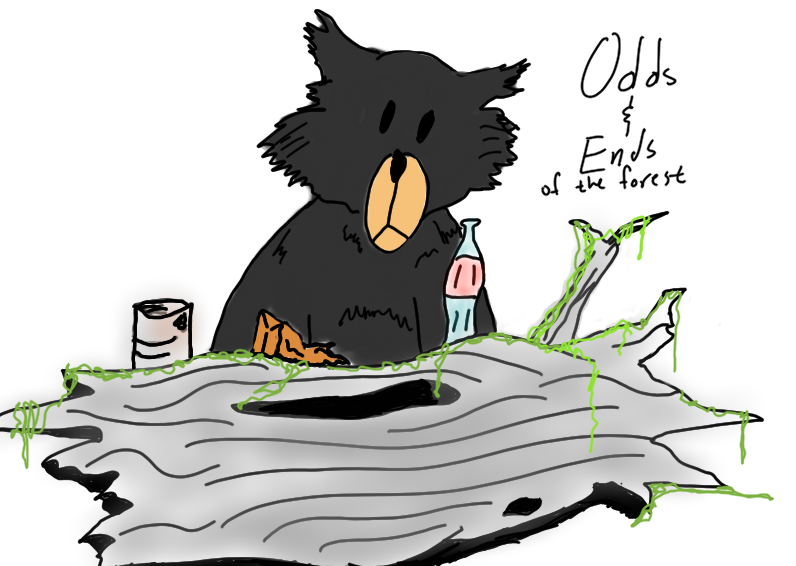
I decided I would try to spread the word of these limitless gifts. Using a moss covered, hollowed out log I found near my cave as a table, I setup a shop that displayed the numerous wonders the forest had to offer. For free, any creature was welcomed to approach my display, ask about an item, and take it back to his/her den.

As I waited for other forest inhabitants to take a gander at my wares, I accidentally ate many of them. At first, I had displayed a fish skeleton, a small bushel of red berries I had never seen before, the aforementioned aluminum can, a glass bottle, a crumpled up paper bag, a tin can, and some sticks.

By the time the first creature arrived, I only had the glass bottle, the tin can, and the paper bag left. She was a raccoon. She must have been in the log the entire time. I had not seen her enter or exit my makeshift table before then. She slowly shuffled out of the log and climbed to the top.

She sniffed the tin can.

She pushed it with her tiny paws.

Then she grabbed it with her teeth and ran away.

Success! I had convinced a fellow forest friend to partake in the wonders of forest foraging. She did not have anything to say about the can other than the distant hisses I heard from the direction she ran toward, but I was still excited at the idea of spreading awareness.

I waited a little while longer for any other forest creatures who wanted to be enlightened. Eventually, the wind picked up the paper bag and carried it off. I had not considered that even elements of the forest might like to enjoy what the forest had to offer. Perhaps the rain would like to try the glass bottle?

I wanted to ensure any creature or thing in the forest who wanted to see my findings could be able to, so I decided to stick around long after my inventory was down to just one glass bottle. I waited for a very long time. To pass the time, I chewed on the moss (another amazing thing to eat in the forest) that covered the old log. Surely there had to be something or someone out there who wanted to hear what I had to share about the forest.

Nobody came. The moon was overhead as I picked up the empty bottle and carried it to my cave. I wanted to spread awareness, which I did to a small extent, but I was saddened to realize very few animals of the forest were interested in what I had to say.

I wanted to help my fellow forest dwellers, but I hardly made an impact when it came to sharing my ideas. I should have been delighted. After all, if nobody wanted to eat the old wallet I found in an abandoned tent, did that not just mean more for me? Yet I could not get over how unheard I felt. I had something to say, but nobody wanted to listen. Even the raccoon did not stay long enough to hear why I had a display of tin cans and paper bags.

I keep a rock in my cave. It rests in the darkest part of my dwelling. When I feel like I have not been heard or when I need to say something that I cannot tell anyone, I tell my rock. I dropped the empty bottle next to the rock and explained how useful item was. I told my rock that it had a wonderful taste and smelled like mold. Then I told my rock about the raccoon and the wind. Then I explained how I felt not being listened to by anyone else.

I think the rock understood. I left the bottle next to it and curled up in a ball to sleep. It is nice to be heard, even by rocks.

I am a bear.

To read more thoughts from this particular bear, interact with the blue or grey parts of this sentence. Also, be on the look out for a new bear adventure.

I think it is okay to not be good at some things.

shame

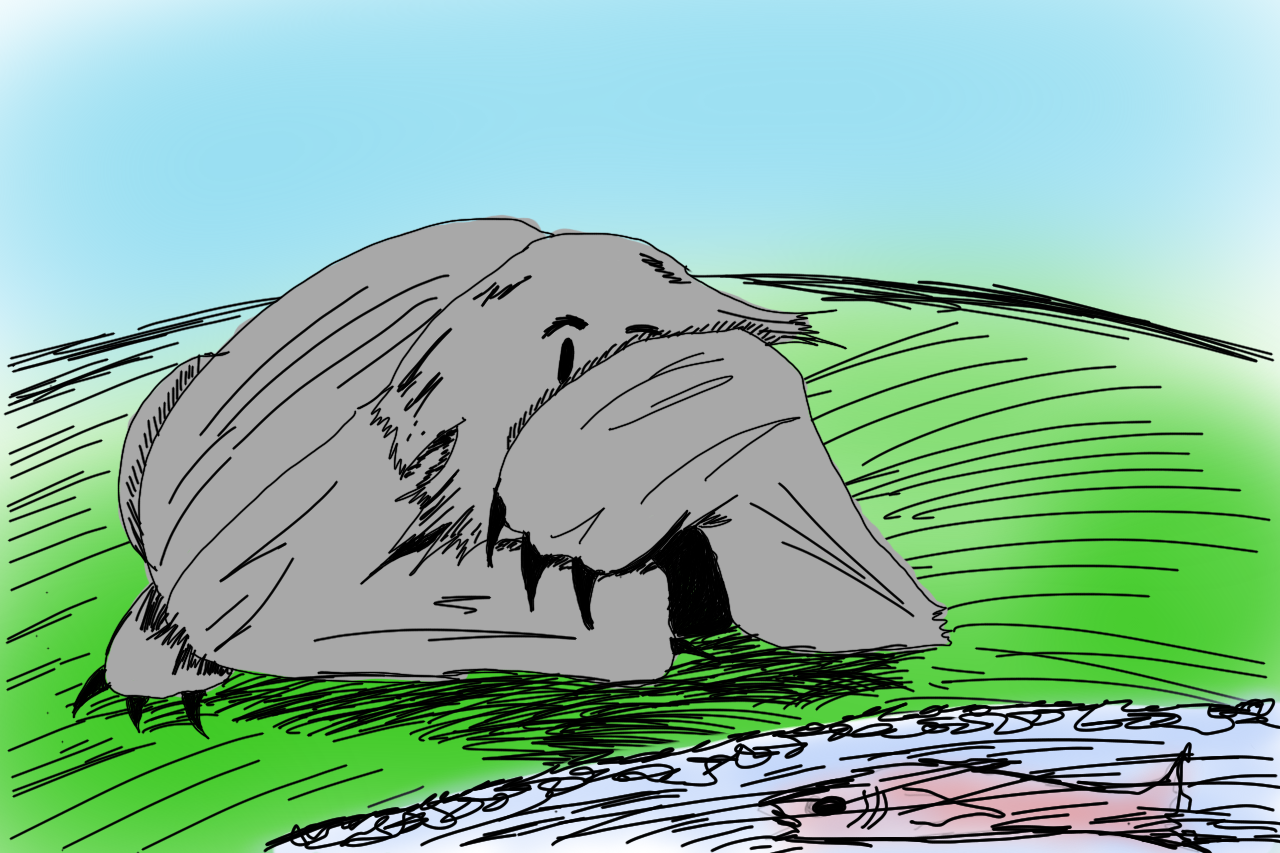
I remember the first time I caught a fish in the river near my cave. I sat in front of the rushing liquid, watching ripples and bubbles caused by the creatures below. I stared for what felt like lifetimes. My front legs were drenched in river water and bits of dirt and grass. I knew the fish were unaware of my presence, but I still felt them mocking me and telling me how terrible I was at fishing, staring, understanding water, and being a bear. They never said anything of the sort, but I felt them think it.

My paw finally swiped one of the mocking fish. I felt its head crush under the thick padding of my paw. I dragged it toward me. For a split second, I felt awful for so swiftly ending another creature’s life, but I was far too hungry to dwell on the thought for too long.

I managed to fish. I was awful at it. I am still not too terribly good at it. It still takes me far too long to time my paws with the rush of the river. I still frequently find myself tripping into the water, scaring all of the fish away.

I am not good at fishing.

I am not good at a lot of things. I try many activities to pass the time in the forest, but I rarely find myself mastering any one of them. I still struggle with identifying bird calls. I am terrible at walking backwards. I usually fail to keep my fur shiny and smooth. I have a very hard time acquiring the proper footing to extensively climb trees.

I am not good at so many things.

When I am alone, being a bear by myself and the like, I am not bothered by my lack of expertise or mastery. Even though I certainly aspire to be good at things and spend a fair amount of time practicing said things, I am okay with my inability to enhance my skillset.

When I am not alone, however, being a bear with others around and the like, I am bothered by my lack of expertise.

Everyone else seems amazing at everything.

I stare in amazement as squirrels zip up trees with great agility. My jaw drops when I witness a bird of prey swoop down into the forest to snatch its meal. I am constantly impressed by the beauty and elegance exhibited by does as they graze the forest floor.

They are so good at eating grass.

And I will never be good at eating grass. At least not that good. I usually throw up when I eat grass. I am bad at eating grass.

It troubles me to be surrounded by expertise that I am not capable of acquiring myself. I want to be good at climbing, finding prey, and eating grass, but I simply am not. I once tried to ask a doe how she got so good at eating grass, but she quickly ran away as I approached. I am sure she would have told me the obvious, though: practice.

And I do. I practice many things, but I never feel like I have mastered any of it. I want to impress others in the forest. I want animals to see me and be amazed by my capacity to be a bear and do bear things. “There goes a bear,” the creatures would say. “He is marvelous at being a bear and doing the thing we are watching him do.”

I wonder what I look like while doing the things I practice on a daily basis. How do ants see me as they witness me try to eat grass? What do the lizards on the trees I climb think about me as I straddle the flimsy limbs and try not to fall? Is anyone impressed by the way I nap in my cave for many hours at a time? I feel like nobody is.

I want to be good at things. I want to be an expert at fishing and swimming and sleeping and eating. I want to, but I do not know if I ever will be. But whenever I find myself dwelling on that want of being a master of anything, I try to think about why I want it so bad.

Do I want to be good at fishing so I can catch fish easier? Not really. I do not mind being bad at catching fish. I really just like swishing my paws through the cool river water. I suppose I want to be good at fishing so others can be impressed by my ability to fish. Does it matter if others are impressed by me, though? Would it make my days easier or the grass on the ground tastier? I doubt it, yet I still crave it.

I need to be okay with what I am capable of. I need to embrace the bear that I am and not be ashamed of the bear I think others see. I need to do these things, but it is difficult. For now, I will keep trying to be a better bear while accepting that I might not ever be the impressive bear I want to be. I think that is okay.

I will also try to eat more grass without throwing up. I like to eat grass.

I am a bear.

To read more thoughts from this particular bear, interact with the blue or grey parts of this sentence.

Do not yell at trees.

tree bear

You should not yell at trees for many reasons. First, and most importantly, they do not like it. While they have never vocalized this, I am eighty-four percent certain it is not a pleasant experience for them. Would you like to be yelled at? Of course not, and you are not even a tree.

If you would, for just a moment imagine being a tree: You are in the middle of a great forest surrounded by your brothers and sisters. A network of wildlife uses your body as a home and/or food source. You produce offspring and help the forest grow denser. You give shade to those who are too large to inhabit you. Some animals use you to mark territory or get rid of waste. Humans often deface you with strange carvings or, in horrible situations, try to take you out of the forest in cylindrical slabs. You have no defense mechanisms, but you must be strong at all times.

Despite being quite impressive and majestic, you are under constant duress to be something to everything.

Now that you are an imaginary tree and can empathize with the plight of trees, picture someone yelling at you. Perhaps your leaves were blown off your branches (something you had no control over) and they landed somewhere someone did not want them to land. Maybe your sap got on someone’s fur. Maybe someone just does not enjoy the texture of bark. Now, how would you feel if this hypothetical someone yelled at you for any of these reasons? Would you need that sort of pressure on top of all the other things you have going on in your life? Of course you would not.

The act of yelling at trees is simply pointless. It does not accomplish anything. You might think that yelling at a tree could be cathartic, but it does not make you feel any better. I know from first-paw experience.

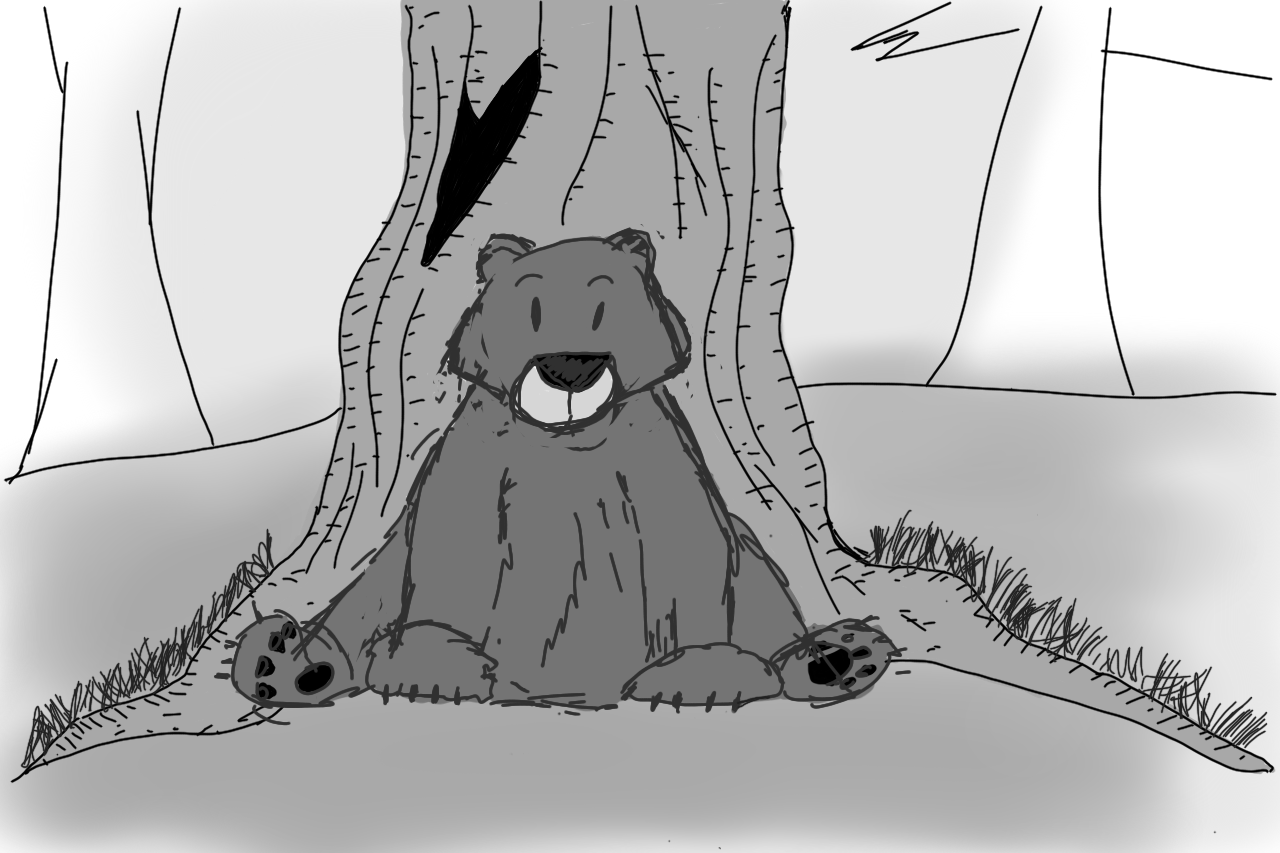
I once tripped and tumbled, head first, into the base of an oak tree. Once I got to my feet, I loudly growled at the tree and asked why it felt the need to strike me. After a moment of silence, I felt ashamed for blaming the tree for my misfortune. After all, I was the one who tripped and tumbled. The tree had always been there. The same place. A constant for the forest. I was the one running about, causing unpredictable chaos. I tripped because of me.

What could I have expected from the tree anyway? If the absurd assumption that the tree was at fault was even remotely true, what could the tree do? No tree has never apologized (not that an apology from a tree has ever earnestly been needed), and this tree was not about to be the first to do so. My whiny howling did not deserve any response beyond what it received: just silence (or just the soft rustling of leaves in the wind).

Rob (the squirrel) once told me he yelled at a tree. He claimed that a tree had tried to run him over while he was crossing a street. I had no idea how or why a tree could or would do that. I also was not completely sure what a street was, but I did know that no tree could ever intentionally, upon its own will, do something so malicious.

I asked Rob (the squirrel) if yelling at the tree had made him feel better. He admitted it had not. He also admitted that the thing that had tried to run him over was likely not a tree. He then seemed embarrassed, which led to him hurling an acorn at my nose and running away. Even Rob (the squirrel), who is characteristically aggressive, blameless, and unashamed by nature, could not place blame on a tree.

Trees are your friends. Even if one falls over and smashes something you love, it is not the tree’s fault. They did not ask to be horizontal. In fact, I am seventy-six percent sure they abhor being anything but vertical. Unless you enjoy pointless acts and looking quite silly, please, do not yell at trees. There are better ways to spend your time.

I am a bear.

To read more thoughts from this particular bear, interact with the blue or grey parts of this statement. It would be fun.

It is nice to have things to remember.

sun and moon (2)

I do not completely understand the purpose of remembering things. I know the ability can be useful sometimes. One time I buried a perfectly good rabbit skeleton next to an old, bug filled log. Several weeks later, I found myself wanting a rabbit skeleton to chew on in the middle of the night. I did not have one immediately, so I used a series of images and smells I remembered to go out and fetch the rabbit skeleton I buried by the log. If I had not had those memories, I would have had to find a brand new rabbit skeleton to chew on. Rabbit skeletons are not very easy to find.

However, for every rabbit skeleton my memories retrieve for me, they also do something that is not so useful or pleasant. All too often, I find myself suddenly remembering something terribly embarrassing for absolutely no reason. Even without putting any effort towards retrieving the memory, I will randomly be reminded of something I do not want to think about. I recently stopped lapping up water mid-drinking because remembering the time I accidentally ate a bee and it stung the inside of my cheek made me feel so embarrassed that I was felt stunned.

Why bother being able to remember embarrassing things? I already made the mistake or recovered from the particular instance of lapsed judgment, so why make me relive it? It seems like a cruel thing for memories to do. I suppose memories want you to be reminded so you will not make the same mistake again in the future, but surely there must be a better way to remind me of that than to make me relive my embarrassment and pain in such great detail.

There are other moments when memories fail to do what they are best at, which is reminding you of something. They might only remind you of parts of something important or just minute details that do not add up to a whole, coherent image. Memories will often only deliver moments of your life to your mind in sporadic, nearly nonsensical chunks. Fragments you have to put together as best you can. Pieces that will never quite fit together no matter how desperately you want them to.

I know I have not always been a single, lone bear. I know, at some point in my life, there were other bears with me. Large bears. Bears my size. Bears who licked the top of my head while I rested by the riverside. Bears who stood up on their hind legs with me, hurling their paws at my face in a playful manner. Bears who kept me safe. Kept me company. Kept me warm.

Those memories, the ones of the bears who must have been an important part of my life at some point, are scattered and difficult to recall. Those are the memories I want to recall, though. Those are the thoughts I want to be randomly reminded of while I sip river water. The fragments of those thoughts are so difficult to hold together, though. Sometimes I even doubt they are real. Maybe I made them up myself. I do not know.

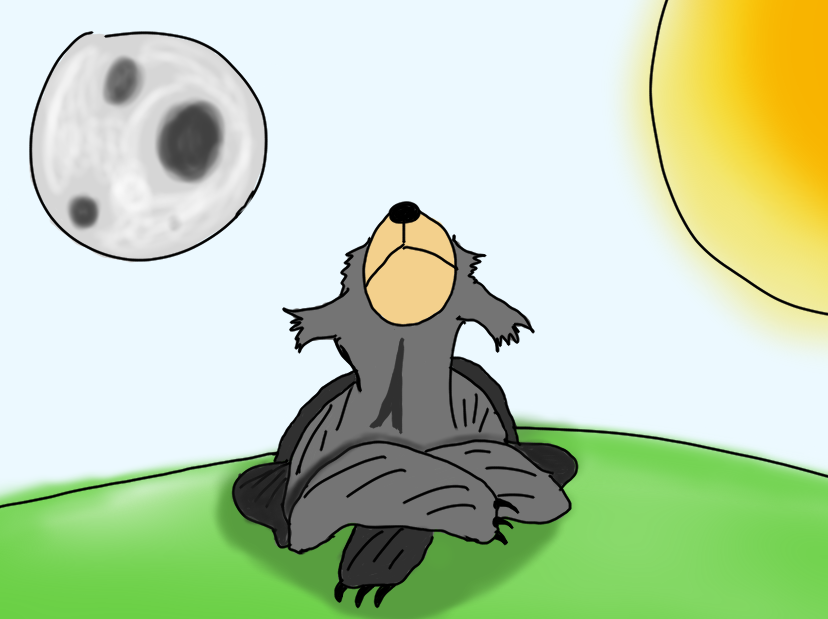
I am still grateful that my head lets me have memories, though. Despite how painful or distant some of them might be, there are still many that are an absolute joy to have and cherish. One of my favorites happened late in the afternoon of an otherwise very regular day. The sun, with its lovely warmth and glow, was beginning to rest into the horizon. At the same time, the moon, with its proudly pale light, was beginning to rise from the horizon. For a little while, the two giants, who normally represented completely different feelings and ideas and temperatures for me, shared the sky above the trees. I stared at the scene for as long as it persisted.

Then a tiny a gnat got caught in my eye, a part of that memory that I feel more distinctly and vividly than any other from that moment.

I am a bear.

You can read more bear thoughts by clicking these lovely blue words.